
Key Points
- Engagement needs to begin early and continue throughout the full project lifecycle.
- There is no one-size-fits-all approach to engagement.
- Indigenous Knowledge strengthens technical decision-making.
- Meaningful engagement can create employment, training and procurement opportunities that support local capacity long term.
Mine remediation projects can span decades, particularly when they involve legacy or abandoned sites where historical information may be incomplete and environmental conditions and risks are not fully understood at the outset. Project teams must balance environmental and regulatory requirements, community priorities and desired future land uses with remediation costs and technical feasibility.
Meaningful engagement with Indigenous communities, leadership and businesses impacted by the project throughout all remediation stages is integral to successful project completion, turning legacy into opportunity.
SRC’s Project CLEANS (Cleanup of Abandoned Northern Sites) demonstrates the practical implementation of an adaptive Indigenous engagement approach. For nearly 20 years, SRC has managed the assessment and remediation of 37 abandoned uranium mine and mill sites in northern Saskatchewan on Treaty 8 territory and the Homeland of the Métis, including the former Lorado Uranium Mill Site near Uranium City, which was remediated in 2016.
The Lorado remediation project has progressed through three broad phases: assessment and planning, active remediation, and transitional monitoring and maintenance.
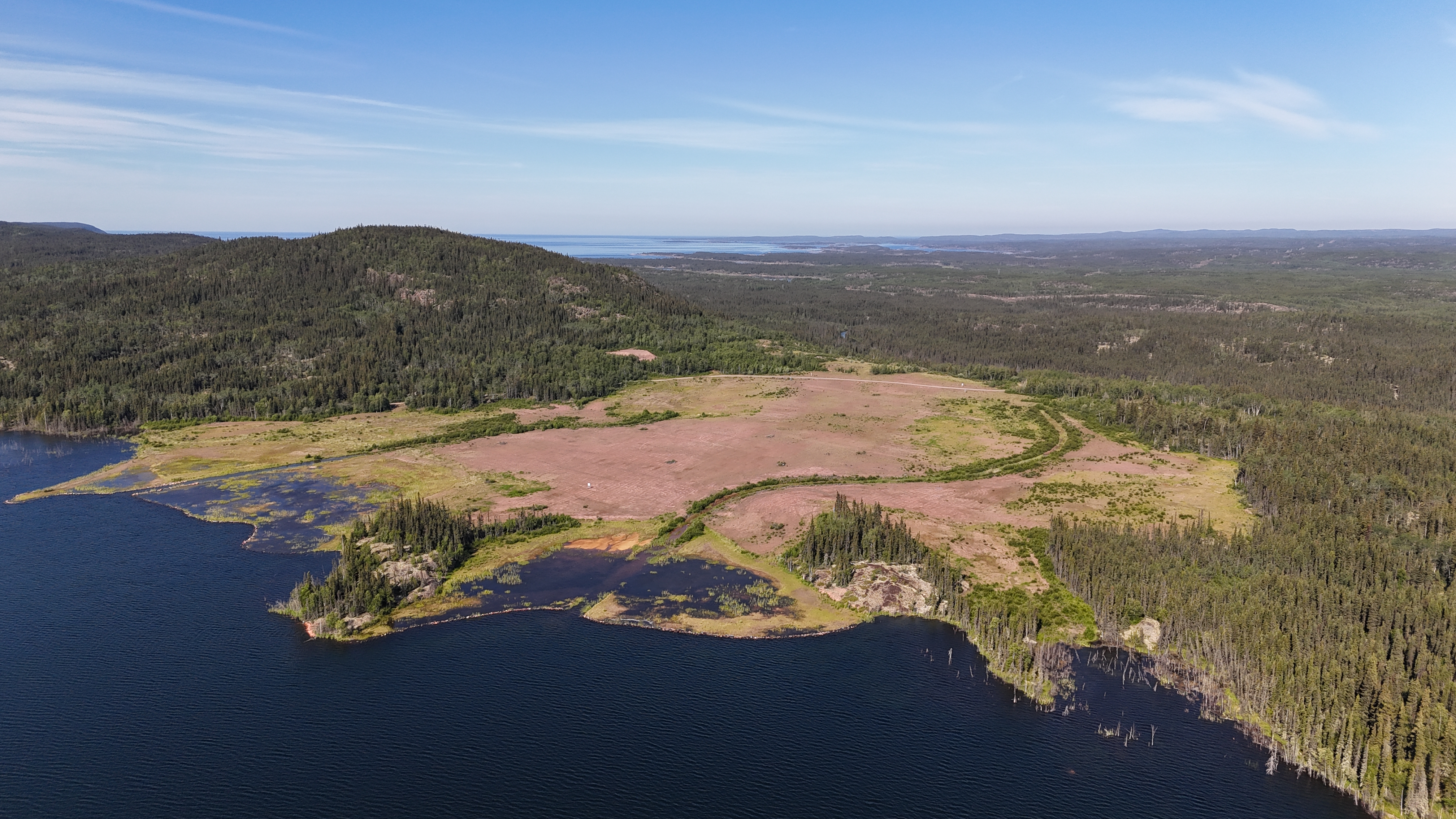
While engagement activities have evolved with each phase, the underlying objective has remained consistent. As Skye Muirhead, director of Environmental Performance, Sustainability and Climate at SRC, explained in a recent webinar with CIM Magazine, “Our main goal is to develop relationships, build trust and maintain that trust with rights holders and stakeholders throughout the project. Trust is the foundation of successful communication and meaningful participation.”
Building Relationships Early
Early engagement is important because decisions made during assessment and planning can shape a remediation project for years to come. Addressing key issues for the community early on builds trust and saves a team from modifying or changing plans later on when it is more costly – both financially and socially.
For Lorado, SRC began discussing site hazards and risks with communities years before remediation activities began. These conversations helped SRC understand how affected communities used the land, their concerns and what successful remediation looked like from their perspective, while also providing an opportunity to discuss regulatory requirements, technical constraints and costs. The communities’ feedback on various remediation options then helped inform the project’s direction.
This process also demonstrated that there is no single approach to Indigenous engagement. As Muirhead notes, “Every community is different and even the residents within that community don’t all have the same opinion.”
Leadership, Elders, business owners, young people, hunters and trappers, land users and other impacted Indigenous and non-Indigenous community members may have different interests and preferred ways to receive information and provide feedback. That diversity underscores the importance of using multiple engagement methods and creating opportunities for diverse voices to participate.
Over the life of Project CLEANS, engagement activities have included hundreds of meetings and workshops, dozens of site tours, community events, educational and training opportunities, videos, newsletters, social media and other communication tools. Community meetings are open for anyone to attend, ask questions and learn about the project.
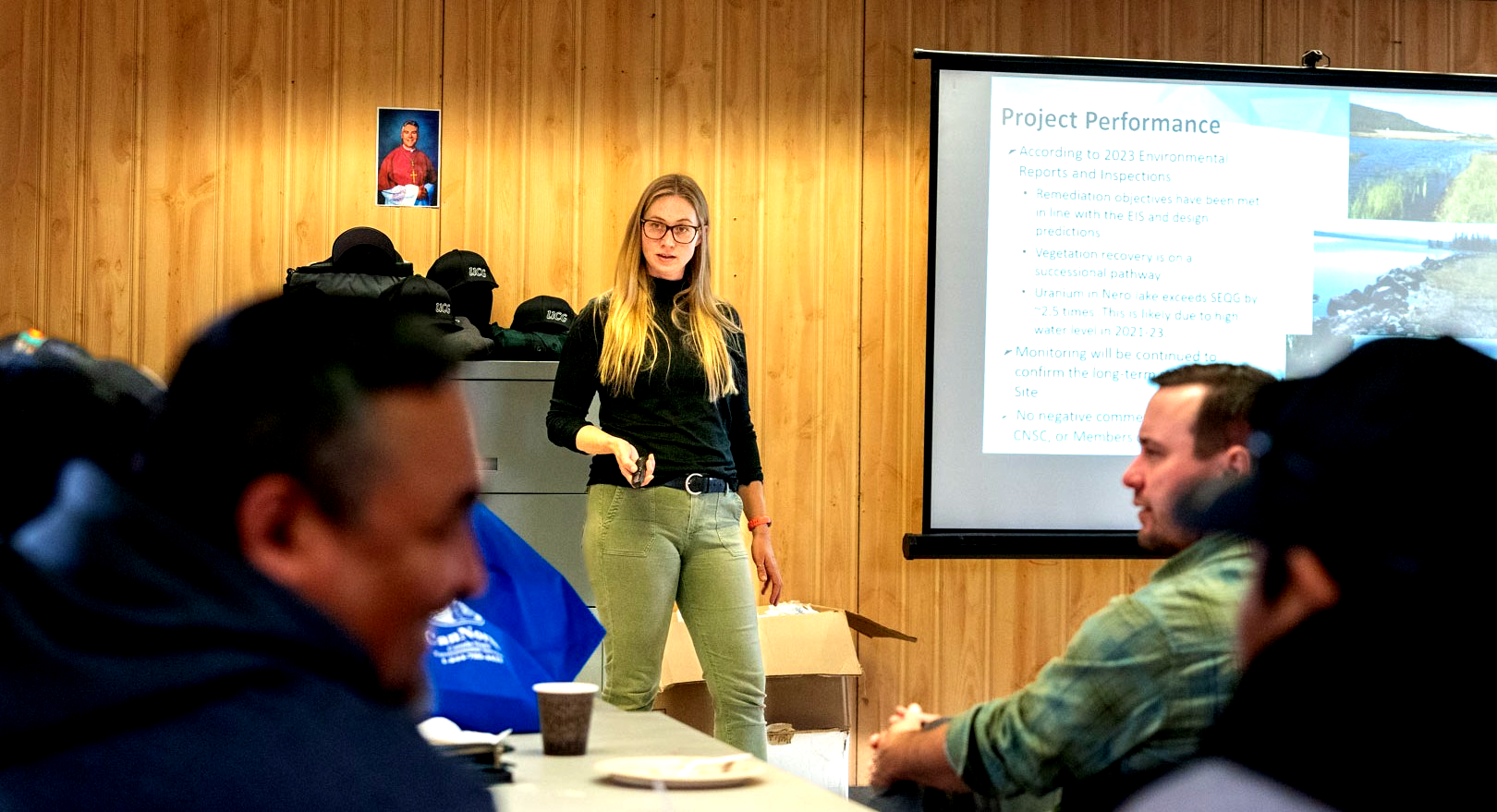
Muirhead explains that who SRC brings to the meetings is as important as how often the team visits. Project managers and technical specialists are joined by engineers, consultants and, when possible, regulators. Including regulators in these conversations helps improve transparency, while having the appropriate experts in the room means questions are answered directly.
Indigenous Knowledge was another important part of assessment and planning. For Lorado, land-use and site-occupancy surveys and traditional food studies helped SRC better understand how people used the area. Community knowledge also helped fill gaps in the historical record. For example, people who had worked at the former mine sites, or whose family members had, shared knowledge and photographs that helped identify past infrastructure.
As planning progressed, Indigenous Knowledge informed discussions about current and future land use and how communities expected to use the area after remediation. This information could then be considered alongside technical studies, regulatory requirements, environmental objectives and project constraints when developing remediation plans that were both effective and achievable.
The objective during this early phase was not simply to communicate a completed plan but to enable actual participation in that plan. By establishing relationships, creating a shared understanding of the project and providing opportunities for community knowledge, priorities and observations could guide the work and contribute to the plan before key decisions were finalized.
From Planning to Implementation
As Lorado moved from planning into active remediation, core engagement activities remained, including community tours, workshops and regular communications. However, the focus of these core engagement activities shifted with conversations increasingly centred on opportunities for Athabasca Basin residents and businesses to participate directly in the work.
For example, while developing the request for proposals for the project’s major remediation contractor, SRC worked with the Prince Albert Grand Council (PAGC), a tribal council representing twelve First Nations in Saskatchewan. A representative recommended by PAGC liaised with SRC’s procurement team, helping them develop the scope and participating in the proposal evaluation process.
The procurement process that SRC developed included targets for Indigenous employment, regional equipment use and spending in the Athabasca Basin. During the two main work seasons in 2014 and 2015, the following targets were met: 51 per cent of person-days worked at the Lorado site were by Athabasca Indigenous people and 60 per cent of the equipment used during those seasons was sourced from the Athabasca Basin region.
The contractor recruited workers directly in the local area and provided opportunities for residents to learn about the work, ask about training and submit resumés in person. Training opportunities included construction safety, equipment operation and the contractor also facilitated provincial driver’s licence testing.
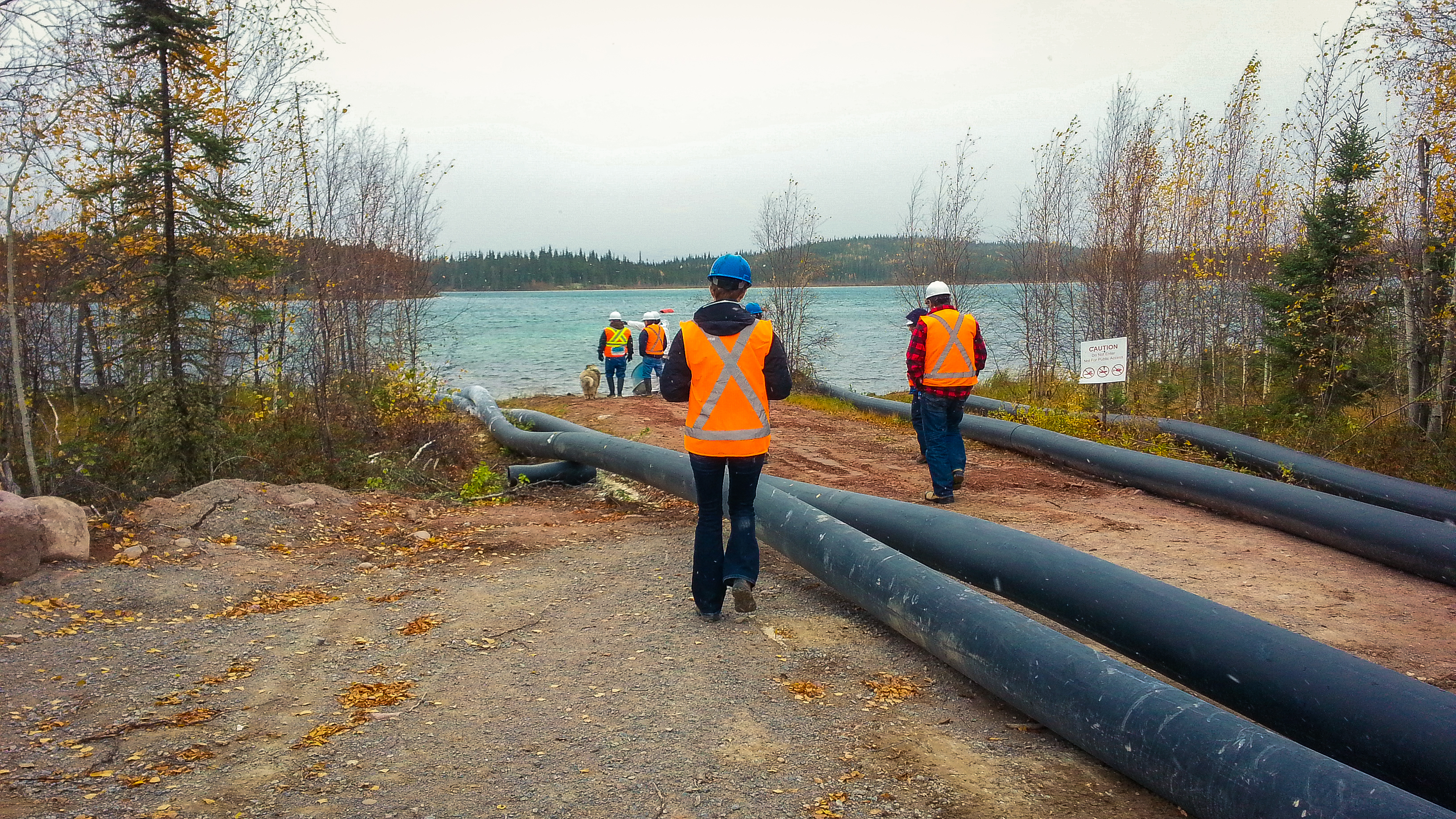
Indigenous Knowledge continued to contribute to the work in practical and valuable ways during remediation. For example, residents made suggestion on where construction materials and subcontractors could be sourced, as well as identifying potential access routes. Elders from different communities were also invited to the site during remediation activities, where they could observe the work, see workplace safety in action and connect with community members working away from home.
The engagement strategy was always more than just the mutual sharing of information. It was about participation, building capacity and sustainability - finding ways for project benefits to extend into the region and its local communities.
The Value of Indigenous Knowledge
Lorado’s revegetation work demonstrates how technical expertise and Indigenous Knowledge can work together for successful project completion. After construction of the tailings cover, a large area required revegetation to help protect the cover from erosion and to return the area to a more natural landscape. The site’s remote location made conventional approaches, such as transporting hydroseeding equipment, challenging and costly.
SRC began with laboratory and field studies to evaluate potential seed mixtures and other options. The team then shared this information in a series of workshops with Athabasca Basin Elders. SRC experts presented the species under consideration and the results of their studies.
Indigenous Knowledge holders provided information on which plants would establish most quickly, which could provide longer-term ground cover and how vegetation could be expected to change over time. They also shared knowledge about planting methods and where particular species were most likely to succeed, based on factors such as slope, shade and moisture.
Together, this shared information helped shape the final seed mixture and revegetation approach, which resulted in a successful outcome, demonstrating the practical value of bringing together Indigenous Knowledge and complementary scientific approaches.
The final approach helped balance multiple priorities; it avoided the logistical challenges and high cost of transporting hydroseeding equipment to the remote site, while creating a more robust cover system that was closer to the area’s naturally occurring vegetation and protected the cover from erosion. Finally, it continued to build trust and acceptance of the project outcomes and build a positive legacy.
The experience demonstrated that community knowledge can help identify solutions that might not emerge from conventional technical analysis alone and it also helped foster stronger relationships.
Evolving Relationships for Long-term Success
Although remediation activities at Lorado were completed in 2016, it did not mark the end of the project or community engagement. Alexey Klyashtorin, a senior environmental scientist at SRC and a project manager with Project CLEANS, explains that transitional monitoring has been underway since remediation and revegetation were completed in 2016.
The goal since then has been to confirm that the work's objectives have been successful, thus proving out the site's long-term stability. Monitoring includes water quality, the integrity of the tailings cover, vegetation development and other environmental indicators.
As visible large-scale activities at the site decreased, community interest naturally shifted, as well. SRC adapted to this by actively maintaining connections and providing information on monitoring results, site conditions and next steps. Local participation has continued through activities such as site inspections.
SRC has worked with the Athabasca communities’ Ya’thi Néné Lands and Resources’ land technician program, which employs people from the Athabasca Basin, to involve local technicians in inspections. Local monitors bring regional knowledge and can observe changes over time, while building additional experience in environmental and regulatory monitoring.
After nearly a decade of monitoring, results indicate the remediation is performing as intended. “To date, all remediation objectives have been met,” Klyashtorin says, noting that the cover remains stable with minimal erosion and that vegetation recovery is progressing successfully.
One result has been particularly significant. Fish have once again been observed in Nero Lake – a dead lake for decades, and a survey confirmed populations of white suckers and minnows. “Such rapid recovery of the lake ecosystem exceeded our expectations,” he says.
Annual community visits and leadership tours continue. As the project team prepares Lorado for transition into Saskatchewan’s Institutional Control Program (ICP), community questions increasingly turn to what will happen after SRC’s involvement ends. Representatives from the Saskatchewan Ministry of Energy and Resources, who administers the ICP program, attend community visits so they can directly speak about the ICP program and answer questions about long-term site management.
This transitional period makes continued engagement particularly important as it also helps preserve knowledge and engage with new generations. People who live in the region, participated in engagement activities or worked on remediation have become important knowledge holders, connecting the sites’ history with the work completed.
The Lorado remediation project demonstrates how Indigenous engagement is not a single project milestone or consultation exercise, nor is it just about communicating project activities. It is an ongoing and necessary participative process that must evolve alongside the work, particularly at legacy sites where environmental objectives, community concerns and expectations, regulatory requirements, technical feasibility and available resources must be balanced.
The engagement progressed from establishing trust through relationship-building and incorporating Indigenous Knowledge during assessment to employment, training, procurement and local involvement in project activities during remediation. Just as important in the engagement was the focus on maintaining relationships and involving local knowledge holders in preparation for the site’s eventual transition to long-term institutional control.
One of the most transferable lessons for industry from Lorado is to continually reassess engagement strategies as a project evolves, drawing on the perspectives of the project team and, most importantly, incorporating communities into the project to understand what they would like to see and how they want to be involved. These long-term relationships are essential to project success and building trust for future work.
Interested in learning more? Watch a webinar on this topic with CIM Magazine.
