
Interested in learning more about SRC's work in hybrid energy systems? SRC and CIM Magazine co-hosted a webinar covering a case study of a 10-year demonstration system at a remote remediation site in northern Saskatchewan. Watch the webinar on demand.
From 2024 to 2025, SRC was contracted by and worked with the provincial power utility, SaskPower, to design, construct, install and commission the province’s first-ever independent community power system of its kind for the small, remote community of Descharme Lake in northern Saskatchewan.
Dubbed the Descharme Lake Microgrid, the power system combines solar panels, battery storage and back-up diesel generators, all located onsite near Descharme Lake, situated 95 kilometers north of La Loche on Treaty 8 territory.
Key Points
- A microgrid replaced aging infrastructure with a more resilient solution for a remote community.
- SRC designed and delivered a hybrid, utility‑grade microgrid that combines on-site solar generation, battery storage, and diesel backup through its Hybrid Energy Container.
- The project demonstrates the broader potential of microgrids for remote and northern communities.
An aging power line, a remote community
A 60-year-old power line servicing Descharme Lake, a community of about 20 households, was nearing the end of its operational life and SaskPower determined it would need to be replaced.
The cost to rebuild another power line would have come with a significant capital cost, according to SaskPower’s Project Manager for capital projects Jordan Humeny. “That coupled with future vegetation maintenance work around the heavily forested Descharme Lake would have also added to costs and further environmental impact,” he said.
“It made this ripe for an opportunity to find an alternative, more effective solution.”
SaskPower needed to ensure that whatever replaced the line would provide efficient, consistent and reliable power to the northern community.
The alternative solution for the 96-kilometre-long power line would also need to function consistently in extremely harsh environments. “The new system needed to reliably operate with no personnel on site through any weather that northern Saskatchewan could throw at it,” Ryan Jansen, SRC’s manager of Energy and Process Solutions, said, adding that it would also need to be easily integrated into the community’s existing infrastructure.
A purpose-built microgrid solution
SRC was involved in the planning from the very beginnings of project conception, Jansen said, drawing on its decade of knowledge and expertise in renewable energy and storage solutions.
“We were involved in the initial feasibility study where we looked at different options for the site, for generation, for storage, what it might look like and what it might cost,” Jansen said.
SRC and SaskPower considered a variety of options before deciding on a microgrid composed of solar arrays and a customized Hybrid Energy Container, the latter of which SRC had experience and proven success in engineering and installing at remote sites in the past.
Choosing to create a microgrid for the Descharme Lake community made sense, Jansen said.
Microgrids – a self-contained electricity generation network that combines power generation, storage and control systems – are ideal for smaller communities and have been used in remote regions throughout Canada.
SRC engineers worked in tandem with SaskPower engineers to come up with the initial design of the microgrid, including customizing a Hybrid Energy Container to address the project’s need for efficient and reliable power.
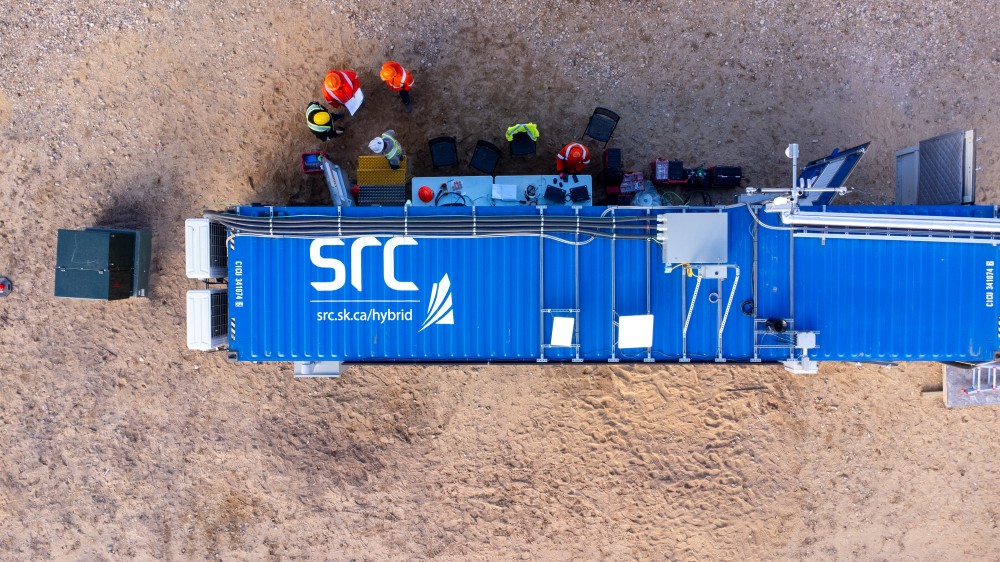
SRC’s Hybrid Energy Containers can be built to meet specific site and client requirements using a unique combination of conventional and renewable generation sources together with energy storage.
One of the benefits of the Hybrid Energy Container was that it could be designed and installed to have minimal physical impact on the community of Descharme Lake. The team designed noise mitigation strategies to minimize disruption, while also ensuring that the site layout would not impose any inconveniences on the local community.
SRC drew on its previous experience of installing a Hybrid Energy Container for the former Gunnar Mine and Mill Site as part of Project CLEANS (Cleanup of Abandoned Northern Sites), a multi-year project the Council is managing to remediate abandoned uranium mine sites in northern Saskatchewan.
Like Descharme Lake, Gunnar required reliable, remotely operated energy infrastructure. The Hybrid Energy Container at Gunnar combined a 60-kilowatt Isuzu generator, 42 kilowatts of battery storage and solar panels, reducing diesel consumption by 86 per cent and generator runtime by 70 per cent.
For SaskPower, the benefits of this type of solution for Descharme Lake were clear.
“The overall significance of the microgrid is that we were able to provide an innovative solution that meets the needs of the community,” SaskPower’s Humeny said. “We’ll see lower operating and maintenance costs over time, and overall, it’ll have a lesser impact on the environment than a traditional power line would.”
Designing a reliable power system
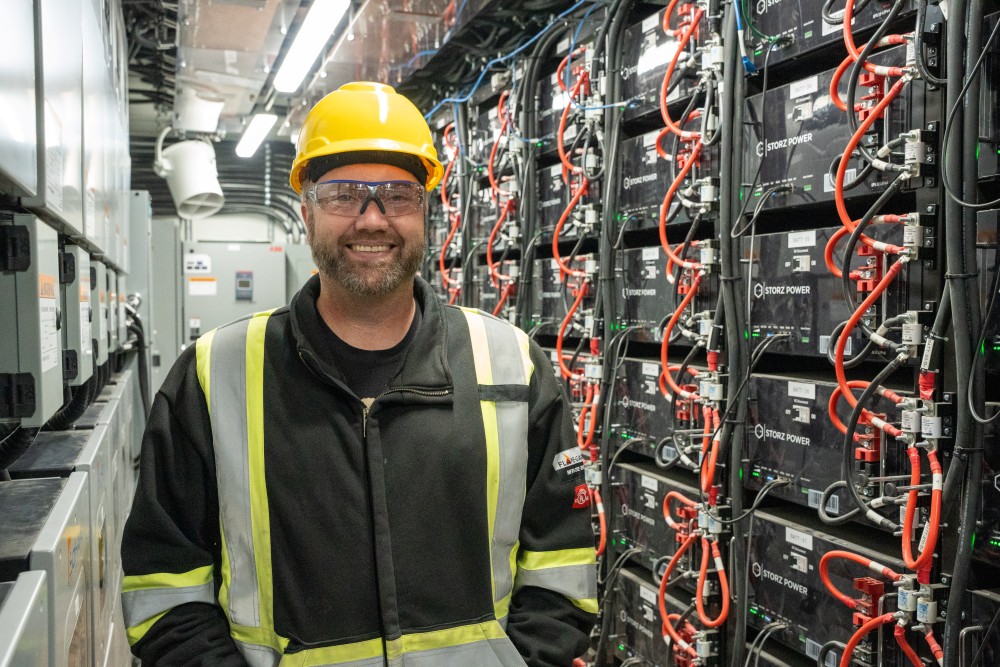
Once the design was approved, SRC’s team constructed the Hybrid Energy Container at its facility in Saskatoon. The container is fitted with lithium iron phosphate batteries to ensure longevity and reliability, and includes new inverter technologies that allow for solar panels and diesel generators to be directly integrated.
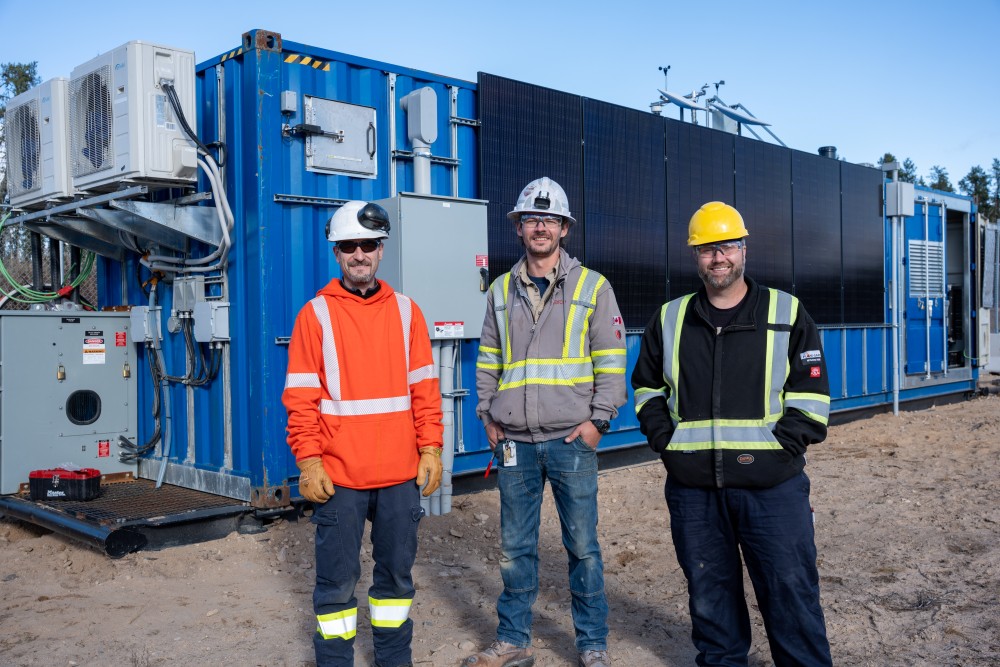
The container was then transported to site where it was integrated with a solar array spanning three acres. There are 468 panels on the ground-mount solar array connected to the container and an additional 6 panels on the container itself for emergency backup power for communication purposes.
Reliability was a particularly important component of the new energy infrastructure, Jansen said.
“SRC has a lot of experience in making Hybrid Energy Containers, so we knew how this system would likely need to work,” Jansen said.
The container is equipped with a power system with a capacity up to 180 kW, and is insulated with its own heating, ventilation and air-conditioning system.
“We needed to build a utility-grade solution,” Jansen said. “We tried to ensure that every system had a backup, and those backup systems have backups. There was a lot of redundancy built in to maintain reliability and resiliency.”
The system is also equipped with technologies to manage the extreme temperature swings found in northern Saskatchewan. The Hybrid Energy Container is equipped with thick insulation to ward off the cold. It also contains a multi-stage heating and cooling system, along with thermal energy storage medium, to both withstand and respond to shifts in the weather.
SRC’s Hybrid Energy Containers have also proven their ability to fully integrate solar power for automatic battery maintenance.
Though SRC has plenty of experience with its Hybrid Energy Containers, developing an effective and efficient solar microgrid that was the first of its kind in Saskatchewan posed some challenges.
“There were probably two or three times when we ran up against a hurdle that felt insurmountable,” Jansen said, such as developing the unique temperature control mechanism for the unit or achieving adequate protection for a high-power, low-voltage system.
But insurmountable challenges are SRC’s sweet spot, where creativity and innovation meet experience and technical know-how to come up with unique solutions. “We had to engineer a way around these challenges to figure out how we could do it safely and reliably and come up with an efficient solution in the end.”
Working together on the container and the microgrid called for heightened levels of collaboration, Jansen said. The teams needed to familiarize themselves with new technologies, designs and equipment, as well as new operating and maintenance practices.
“It involved very significant collaboration between SaskPower’s internal resources, as well as SRC’s design team,” Humeny said.
While SRC designed and developed the Hybrid Energy Container, the project team also tested and piloted the energy infrastructure.
SRC, along with SaskPower, are now in the process of developing sound operating and maintenance practices for microgrids and the Hybrid Energy Container, as well as drafting in-depth training manuals for the microgrid system and container to be used at future sites.
Made-in-Saskatchewan solution for a changing energy landscape
The new microgrid at Descharme Lake has been operating successfully since the spring of 2025. It can produce up to 234 kilowatts of solar power, 180 kilowatts of inverter power and 80 kilowatts of power per diesel generator. In the first six months of operation, the system supported the community with 100% solar-battery energy, and the generator was not required at all.
This innovative solution provides reliable power to the community and met the needs of SaskPower, integrating customizable features to both generate and store energy. The ability to monitor and control the system remotely means more reliable and continuous power, and fewer onsite resources for maintenance.
And its rugged design incorporates an advanced level of durability to hold up in even the most extreme weather conditions.
“The goal was to provide an efficient means of generating dependable power for a remote community and now that it’s been installed and is operating, there’s a deep sense of satisfaction because the system has really achieved its purpose,” Jansen said.
The Descharme Lake Microgrid demonstrates that this type of integrated energy technology solution has the capacity to reliably power remote communities, work sites and more across Saskatchewan and beyond.
