
Nuclear power is experiencing a global resurgence.
Advanced technologies are leading to new generations of reactors, including small modular reactors (SMRs) and microreactors, that are being considered by many jurisdictions around the world as key pieces in the transition to a low-carbon economy.
Saskatchewan is one of several provinces across Canada looking at nuclear power as one way to reduce carbon emissions while keeping up with the growing demands of population and industry.
There’s sound reasoning for Saskatchewan to be exploring this. Uranium mining is a main economic driver in the province. A 2021 Angus Reid Institute survey found that nearly three-quarters (74%) of Saskatchewan residents polled said they would be comfortable with a nuclear power plant in their province. Plus, the province has the nuclear research expertise it needs right in its own backyard!
The Saskatchewan Research Council (SRC) is leading a multi-year microreactor program through the licensing and regulatory process and, ultimately, through to operation.
Micro in size, but huge in potential
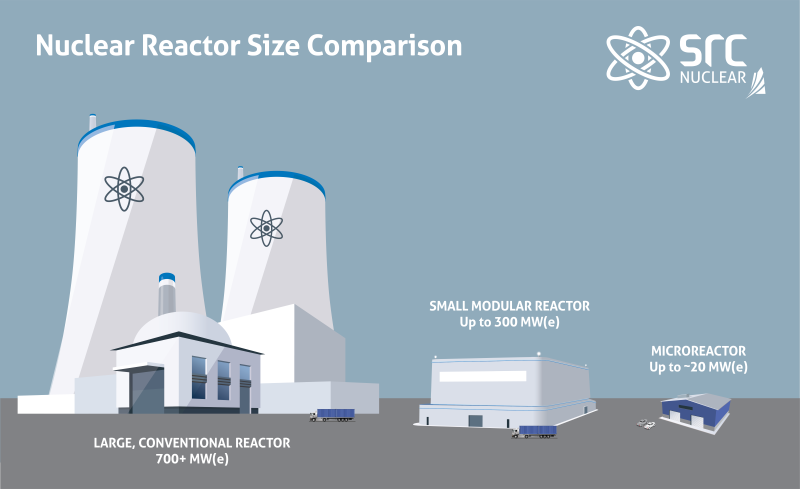
Microreactors are quite different from the CANDU nuclear power reactors currently in operation in Ontario and New Brunswick. Microreactors are small, safe and, when compared to larger nuclear reactors, simple.
They are also different than the SMRs that SaskPower is exploring for the purpose of grid-scale power generation.
Applications in Saskatchewan
In northern Saskatchewan, microreactors have the potential to end reliance on diesel. A microreactor could serve as an on-site district heat and power source for a remote community’s homes and essential services like a school, health centre or its local industry.
Aside from being a power source for edge-of-grid or off-grid communities and industries, a microreactor could have many other valuable applications that could be especially beneficial in Saskatchewan.
One example would be integrating a microreactor with wind or solar microgrids to provide a stable baseline of power to complement the more intermittent power sources which rely on the elements alone.
Another example would be “net-zero” mining. Companies in the mining sector are looking for cleaner energy options such as nuclear for their operations rather than conventional energy sources that create carbon emissions.
Microreactors are being considered globally for a number of other applications as well, including hydrogen production, powering AI data centres, desalination to make saltwater drinkable and defence or emergency response uses.
SRC will be looking at various types of microreactor technologies of varying scale and size and their potential applications for the unique needs of Saskatchewan industries.
Why SRC?
SRC safely operated a nuclear research reactor for nearly 40 years and completed its decommissioning in the fall of 2021. SRC is also home to the world’s largest uranium laboratory and has the expertise, the reputation and the safety culture needed to do this work. For 75-plus years and counting, SRC has taken a challenge and asked the question, “What technology can be the solution?”
Flipping the switch on a microreactor doesn’t just happen overnight, however. While one can think of a microreactor as the car, it still needs a licensed driver to operate it and the rules of the road to be clearly laid out.
The Canadian Nuclear Safety Commission (CNSC) has a thorough list of requirements – ranging from community engagement, to the safety of the technology and its operator, to its plans for operation – that must be met before a licence will be granted.
SRC is the sole organization authorized to hold the regulatory licences and be the licensed operator of microreactors in the province while the sector is in the early stages of commercial development.
“What we learn through the initial microreactor demonstration will help SRC provide a one-stop-shop for industrial companies and Indigenous communities looking to progress microreactor projects in the province, from early feasibility to full reactor operation," SRC President and CEO Mike Crabtree said of the program. "Microreactors will provide a custom solution as part of Saskatchewan's future energy needs and this sector has the opportunity to be transformative for our economy, industry and communities."
To follow the advancement of SRC’s microreactor program, visit srcnuclear.ca.
