
Key Points
- Piloting can reduce risk and save significant time and money before commercialization.
- Successful scale-up requires testing under real-world conditions.
- There is no one-size-fits-all approach to piloting, making expertise critical.
In today’s fast-moving world of digital transformation, risk-return trade-offs and the race to be first to market define success. As a result, technology developers (and early adopters) often face a challenging decision early on: whether to invest both time and money in testing and derisking stages to optimize and pilot, or push ahead, scaling up to commercial operations and going straight to market.
Often times, taking the time to invest in a peer review, feedback and navigating the testing and validation process might seem like a capital crusher (or money pit), but if done at the right time by the right experts and at the right scale, it could end up saving time and a company (and its investors) millions.
Enter piloting.
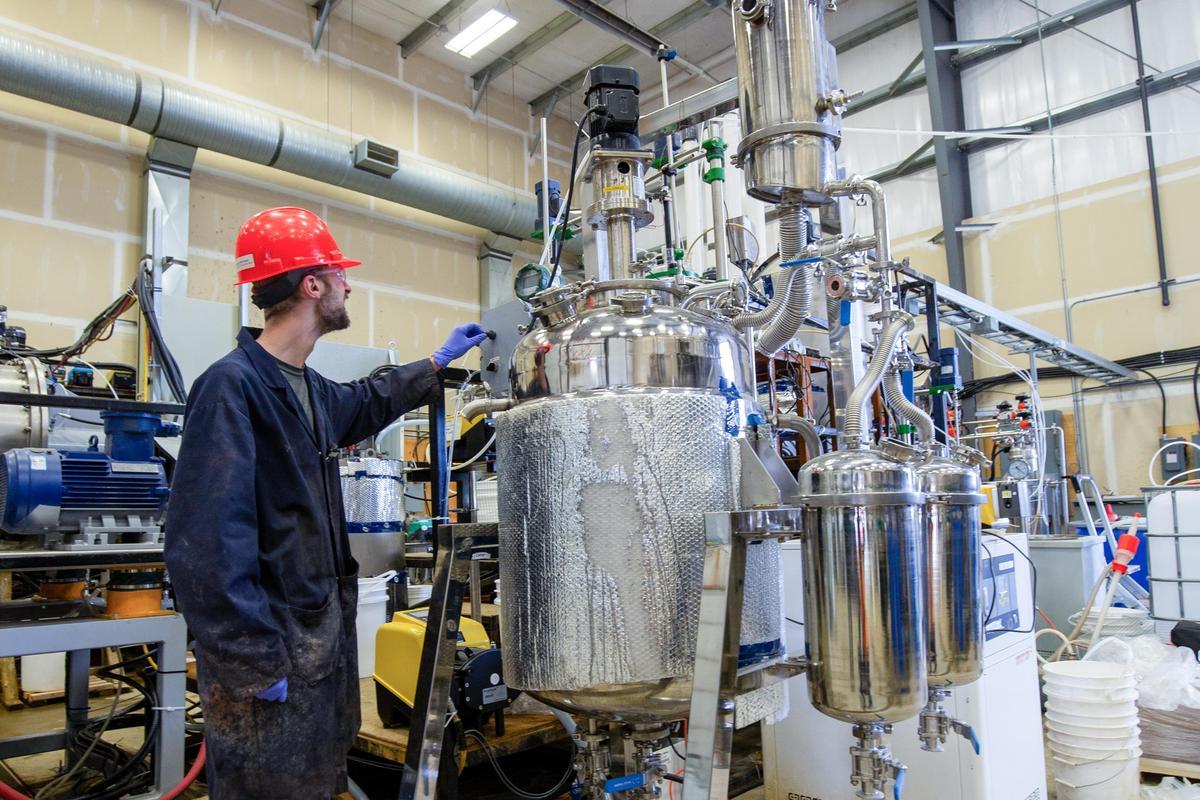
Piloting is a process of testing a technology, process or system on a specific scale that can simulate conditions in industrial environments, either as a trial run or proof of concept. Piloting is an opportunity to understand performance and parameters that can only be demonstrated at an industrial scale.
Pilots can either be set up in a facility that replicates an industrial environment or in the field with real operators and real materials under real conditions. Both require specialized expertise and an advanced understanding of the parameters that influence industrial processes, as well as the ability to design tests that accurately simulate and scale those processes and be representative of the geologic environment.
“Piloting builds your confidence in the process or technology you’ve developed,” said Mike McCubbing, Director of Sorting and Separation at SRC. “It helps you figure out the effect of some of the unknowns when you scale up from theoretical to a practical perspective.”
TWO STEPS FORWARD (Hopefully) NO STEPS BACK
Piloting is a journey and can have many objectives.
Validation, confirming performance, determining operational criteria or supporting geological models that can be used in operations are some of them. Even producing a product that can be used to show investors that the process or technology produces a product of sufficient quality. Or testing the safety for licensing purposes of new technologies.
“There often seems to be time to re-purchase a piece of equipment that was not sized correctly or spend millions replacing slurry pipelines that rapidly erode because of unknown fluid dynamics factors,” said Lucinda Wood, Director of Business Development at SRC, “but not enough time to derisk these through testing before purchase or construction.”
Starting with a strong foundation built on data-driven testing strategies not only reduces risk but overall project development costs.
“It all comes down to risk,” McCubbing said. “If you can absorb some of that risk and you want to move the project along on a shortened time frame, then you could skip the piloting step. But again, you’re now assuming that the modelling and your equipment and technology is going to hold up long-term and under varied conditions.”
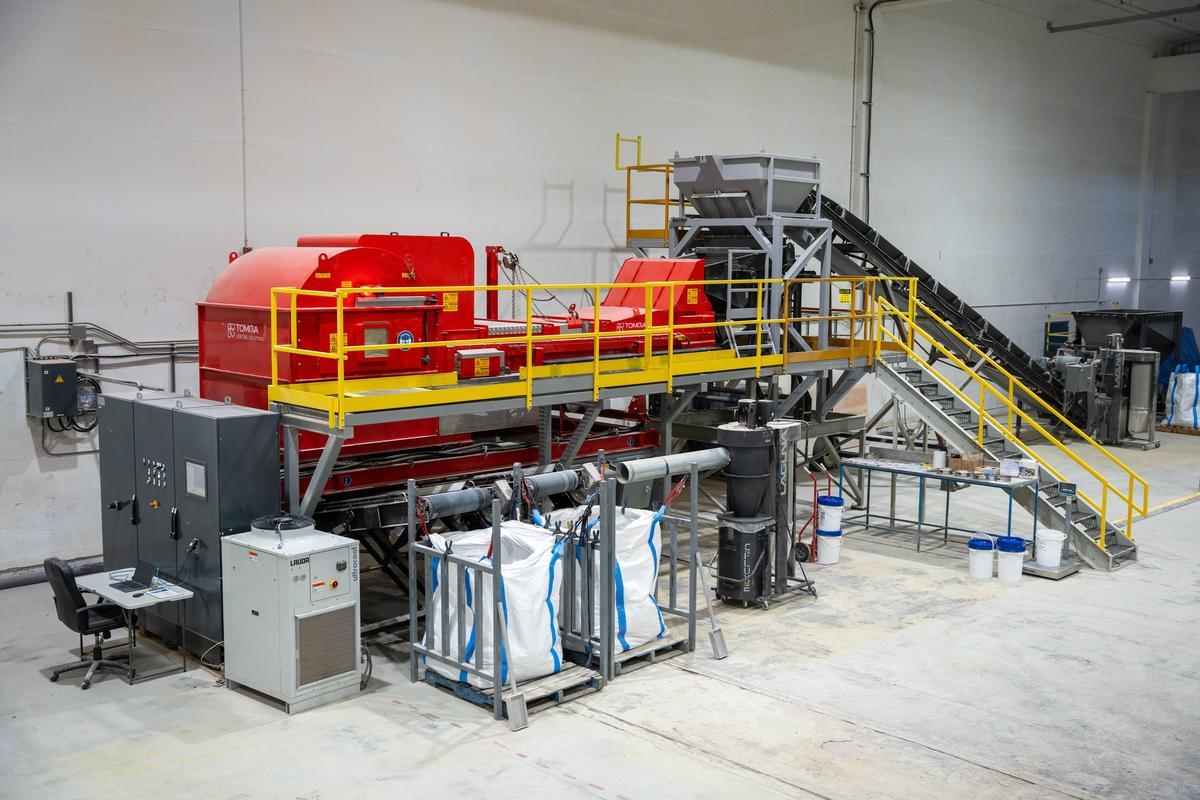
Piloting is the final testing stage at an industrial or near-industrial scale, where the technology or process can be performance-tested and key design criteria, like consumables, can be obtained. The goal of piloting is to confirm performance, identify any issues arising from complex industrial situations (versus in a sterile laboratory) and independently validate technology for investors and clients.
WHEN PILOTING IS CRITICAL BEFORE SCALE-UP
Piloting aims to answer questions surrounding technology performance and efficiency: Does it work as expected? Are there any issues that arise when scaling up? Have variations in the ore body been sufficiently represented? How well does it integrate with existing workflows and processes? What adjustments need to be considered for successful, commercial implementation of the technology?
For nearly 80 years, SRC has been helping companies across the globe answer these questions, advancing technology readiness levels.
McCubbing said the best time to pilot is once you’ve secured proof of concept, and the decision to move to a pilot is a strategic growth endeavor.
If it occurs too late in the development process (or not at all), a company could spend money on rework or production losses; too early and the risk is spending time and money on a large sample collection or prototype development before process parameters are fully understood.
McCubbing pointed to mining operations as an example. “You can’t get a good representation of your ore body with a couple pails of rock or a pallet full of drill core. If you’re using that information to make decisions on treating millions of tonnes of material, it could lead you down a path to failure.”
However, taking a closer look at the characterization of the small samples, for example, can provide valuable information to help develop pilot testing strategies and potentially understand why a pilot hasn’t performed as anticipated.
“A pilot on a non-representative sample that supports the investment of millions of dollars to bring new processes on, then seeing it fail because the mineral deposit changed, could have all been prevented if there would have been a bit more due diligence done up front, rather than rushing to a decision to scale up,” McCubbing said.
“Spending time understanding feedstock complexity and behaviour before piloting is key.”
SRC has the expertise, experience and facilities to design and run pilots, as well as interpret the data, supporting industry and technology developers to move ahead effectively and with confidence. Because what works as an idea, even with extensive bench-scale testing, doesn’t seamlessly translate to industrial-scale operations.
NO UNIVERSAL PILOT MANUAL
The journey to piloting does not always run smoothly. Variables can always bubble to the top and introduce challenges or alter the trajectory of the project. This can feel like an obstacle in the development path to commercialization, but they are often necessary challenges in successful implementation.
This is almost always true when scaling up because simply put, when you have step changes in equipment capacities, inputs and outputs, as well as continuous operations, the math changes accordingly.
“Every time you try a new process that involves multiphase flows, it is highly likely that you need a pilot,” said Reza Hashemi, Director of the Pipe Flow Technology Centre™ at SRC. “The hydrodynamics is complicated and there’s no universal model where you can take your process to scale it up correctly.”
“Just because it works on a smaller scale, there’s no guarantee that it works the same way on an industrial scale, so it’s important to figure out these issues with a pilot. No process is the same, no technology is the same and no pilot is the same.”
Hashemi recalls a recent pilot project where PMAP Mine Water, a Canadian innovative mine wastewater treatment company, sought SRC’s expertise to test out a new technology they developed for in-situ treatment of mine wastewater.
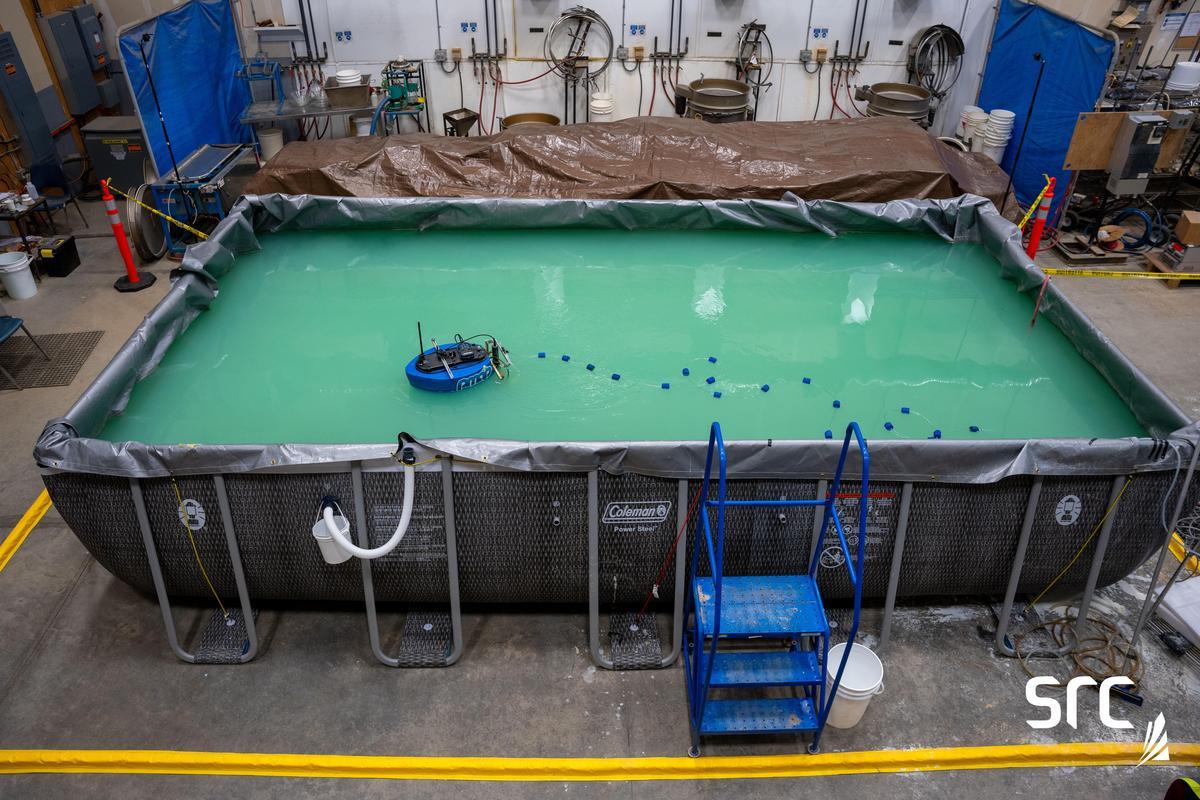
SRC provided third-party, independent validation on an unmanned “smart boat” instrument PMAP had developed and were looking to test at a larger pilot scale.
“The next step was going through the stages of setting up the pilot,” Hashemi said. “We worked with the client to figure out their commercial objectives, the purpose of the pilot and what outcomes they wanted to achieve.”
From there SRC’s Pipe Flow Technology Centre™ mapped out and developed the pilot, setting up and sizing all the equipment to match the scale the client was looking for to demonstrate on a larger scale how the technology works.
Included in this custom-built pilot setup was assembling an above-ground reservoir inside SRC’s facilities and creating a digital twin of a real-world tailings pond. This pilot allowed PMAP to test the smart boat’s capabilities under field conditions, to remotely treat the water with its own technology and then evaluate the results.
RISKS OF SKIPPING THE PILOT
Not all processes or technologies need a pilot. Some technologies can be scaled or applied directly to industry. But it’s critical to understand when and why a pilot is needed.
If a pilot is important to derisk scale up, bypassing the piloting stage means skipping an important step – one that could have lasting effects on a company’s balance sheet.
“There’s often a perception that piloting is too expensive and it takes a lot of time but that isn’t necessarily the case,” McCubbing said.
An upfront investment in testing could reduce the financial risk of more expensive equipment, installation and operations costs.
“You face a major risk skipping the pilot phase because there will no doubt be many issues in operations that you might not have seen in the lab-testing environment,” said Jack Zhang, Senior Director, Strategic Technologies at SRC. “When you go directly to industrial scale without piloting, you may find that not only is performance reduced, your equipment may not work at all. This could mean that the project development is stopped in its tracks.”
Hashemi recalls a time when a client did not pursue SRC’s recommendation for piloting work. They scaled up and implemented the technology based on lab results but afterward, sought SRC’s expertise to troubleshoot when the process wasn’t performing in an industrial setting. This ended up costing the client more time and money.
“There are unfortunately plenty of examples where companies have come to us after they’ve purchased all the equipment needed for a large-scale plant,” Hashemi said.
“We had to tell them all the equipment they purchased couldn’t be used because it was not sized to scale,” Hashemi said, adding a pilot test of the process could have given the same answer before the equipment was purchased.
GLOBAL LEADERS IN PILOTING
At SRC, experienced scientists and engineers have built and run hundreds of pilots at varying sizes and scales and for many different objectives.
“We have the expertise, experience and knowledge because we’ve been working for so many years in this field. We have the facilities on hand and the capabilities to tackle various kinds of pilot projects,” Zhang said.
“We can perform very complicated processes in a relatively short time,” Zhang added, noting his team built a lithium hydroxide pilot plant to create battery-grade product at sufficient quantities through a continuous 24/7 process, with the objective of proving out the process and product quality.
“The client had been told it would take at least 18 months, but SRC was able to set up the pilot and have it operational in six.”
One of SRC’s greatest strengths lies in its ability to pilot technologies and processes across a full spectrum of complexities, scales and materials. From small, bench-top experiments to large, field demonstrations, this capability gives SRC and its clients the ability to move innovations from concept to commercialization with confidence.
“What we do at SRC using a combination of expertise, equipment and experience is incredibly unique and SRC has positioned itself as a one-stop-shop for piloting, validation, process analysis and efficiency testing. We may discover that the technology is not the right fit for your project,” Hashemi said. “We’re an independent testing facility that is here to find the best solution for our clients.”
In the mining industry, piloting is key for project development. It’s also an industry SRC serves extensively with clients located across the world.
“No mining project is the same, even though they have the same commodities, there are always variations in ores and conditions,” McCubbing said. “Not all processes are the same either and shouldn’t be treated that way.”
Over the course of its nearly eight-decade history supporting and driving economic growth in Saskatchewan, SRC’s team of experts are tackling current, new and emerging industry challenges and technologies on the global stage. This experience allows SRC to approach piloting with a holistic lens to identify, understand and solve the variables and challenges that their clients face early in the process.
For more specific case studies of successful pilots at SRC, here are some examples:
